LabVIEW Advanced Programming Techniques, 2nd Edition
LabVIEW™ Advanced Programming Techniques
SECOND EDITION
by : Rick Bitter, Taqi Mohiuddin, Matt Nawrocki
As the power of the standard personal computer has steadily evolved, so have the capabilities of LabVIEW. LabVIEW has simplified the working lives of thousands of scientists, engineers, and technicians, and has increased their productivity. Automation has reduced the costs and increased the manufacturing outputs of factories around the world. Cycle times for product development have been shortened and quality of many products has steadily improved. LabVIEW does not get credit for all of these improvements, but has without question played a valuable role in many organizations for accomplishing these goals.
The chapters in this book are written in a manner that will allow readers to study the topic of interest without having to read the contents in sequential order. Users of LabVIEW with varying levels of expertise will find this book beneficial.
Download :
LabVIEW Advanced Programming Techniques Part-1, Part-2
Read More......

iPod Repair
iPOD REPAIR
QuickSteps
by BRANDON JONES and MARC CAMPBELL
Overview
Like every other electronic device, iPods break down. Until now, the prospect of repairing an iPod was daunting, if not nearly impossible for the average user. In this full-color, inexpensive guide, the owner of the fastest-growing chain of iPod repair shops in the U.S. shares the secrets of figuring out what is wrong with an iPod and fixing it--without paying costly repair bills. He also reveals how to make an iPod work even better.
Download : iPod repair part-1, part-2
Read More......

RF Circuit Design

RF Circuit Design
By : RICHARD CHI-HSI LI
Page : 843
Copyright © 2009 by John Wiley & Sons, Inc. All rights reserved
Book Contents :
PART I: INDIVIDUAL RF BLOCKS (CHAPTERS 1 TO 7)
• LNA (Chapter 1 )
• Mixer (Chapter 2 )
• Differential pair (Chapter 3 )
• Balun (Chapter 4 )
• Tunable fi lter (Chapter 5 )
• VCO (Chapter 6 )
• PA (Chapter 7 )
PART II: DESIGN TECHNOLOGIES AND SCHEMES (CHAPTERS 8 TO 17)
PART III: RF SYSTEM ANALYSIS (CHAPTER 18)
Download : RF Circuit Design PART-1, PART-2&3
iPhone The Missing Manual

iPhone The Missing Manual - Second Edition (Covers the iPhone 3G)
By : David Pogue
Publisher : O’Reilly Media
August 2008
In the first year of the iPhone’s existence, Apple sold 6 million of them, brought the thing to 70 countries; and inspired an industry of misbegotten iPhone lookalikes from other companies. By the end of Year One, you could type iPhone into Google and get 229 million hits.
Now there’s a new iPhone, the iPhone 3G. More importantly, there’s a new version of the iPhone’s software, called iPhone 2.0. And then there’s the iPhone App Store, which offers thousands of add-on programs written by individuals, software companies, and everything in between. This is huge. Remember how mystified everyone was when Apple called its music player the iPod—instead of, say, iMusic or iSongs or something? The reason was that Apple had much bigger plans for the iPod—photos, videos, documents, and so on. Maybe they should have saved that name for the iPhone.
Yes, the iPhone is still an iPod. And it’s still the best Internet phone you’ve ever seen. It shows fully formatted email (with attachments, thank you) and displays entire Web pages with fonts and design intact. It’s still tricked out with a tilt sensor, proximity sensor, light sensor, Wi-Fi, Bluetooth, and that amazing multitouch screen.
Therefore, it’s still a calendar, address book, calculator, alarm clock, stopwatch, stock tracker, traffic reporter, RSS reader, and weather forecaster. It even stands in for a flashlight and, with the screen off, a pocket mirror. But now, thanks to the App Store, the iPhone is a fast, wicked fun pocket computer. All those free or cheap programs can turn it into a medical reference, musical keyboard, time tracker, remote control, voice recorder, tip calculator, e-book reader, and so on. And whoa, those games! Hundreds of them, with smooth 3-D graphics and tilt control.
The purpose of this book, then, is to serve as the manual that should have accompanied the iPhones—both the original and the iPhone 3G. (If you have an original iPhone, this book assumes that you’ve installed the free iPhone 2.0 software, described in Appendix A.)
Download :
iPhone The Missing Manual
The Art of Multiprocessor Programming

The Art of Multiprocessor Programming
Author : Maurice Herlihy, Nir Shavit
Publisher : Morgan Kaufmann
Page : 529
Overview
The first third covers the principles of concurrent programming, showing how to think like a concurrent programmer. Like many other skills such as driving a car, cooking a meal, or appreciating caviar, thinking concurrently requires cultivation, but it can be learned with moderate effort. Readers who want to start programming right away may skip most of this section, but should still read Chapters 2 and 3 which cover the basic ideas necessary to understand the rest of the book.
We first look at the classic mutual exclusion problem (Chapter 2). This chapter is essential for understanding why concurrent programming is a challenge. It covers basic concepts such as fairness and deadlock. We then ask what it means for a concurrent program to be correct (Chapter 3). We consider several alternative conditions, and the circumstances one might want to use each one. We examine the properties of shared memory essential to concurrent computation (Chapter 4), and we look at the kinds of synchronization primitives needed to implement highly concurrent data structures (Chapters 5 and 6).
Download :
ebook on rapidshare
Embedded Systems Firmware Demystified
Embedded Systems Firmware Demystified
Author : Ed Sutter
ISBN: 1-57820-099-7
The goal of this book is to prepare you for a real embedded systems project by walking you through an entire embedded systems design. Not coincidentally, the project source code included is a piece of firmware — an embedded boot platform — that can simplify all your future projects. I assume a small hardware design with CPU, memory, and some peripherals. I present a basic schematic and walk you through the method in which instructions are fetched from memory. I discuss devices, as well as concepts. I examine flash memory versus EPROM, SRAM versus DRAM, microcontroller versus microprocessor, and data bus versus address bus. I also explain how you convert your C and assembly language source code to a binary image that ends up in the memory device from which the CPU boots (the boot flash memory).
Several chapters cover the basic steps of starting up an embedded system and getting a working application (including the basic boot in assembler), exception handling, flash memory drivers, a flash file system, and serial and Ethernet connections. The result is an understanding of how an embedded systems project gets started and how to build a platform on which an embedded systems application can reside.
Download ebook on :
Easy Share
Ziddu
Read More......

Getting Started in Electronic
Getting Started in Electronic (Radio Shack)
By Forrest M.Mims
Page : 128
Overview:
Basic Book For Learning Electronic, electricity, Great Book for Student and Beginner
Download ebook on :
Rapidshare
Read More......
Digital Storage in Consumer Electronics
Digital Storage in Consumer Electronics
The Essential Guide (embedded technology)
Thomas M. Coughlin
ISBN: 978-0-7506-8465-1
Demand for digital storage is driven by the growth in personal family content, by the growing number of entertainment devices in and around the home that require digital storage, by the increasing resolution of personal and commercial entertainment content, and by the growth in the number of channels that people can use to access all types of content.
More consumers have digital still and video cameras, either as stand-alone devices or in convergence devices such as cell phones. Content creation devices such as digital still and video cameras are becoming a common standard application that can be built into consumer devices. In addition to being ubiquitous, camera resolutions make digital storage demands higher with time.
Download ebook on :
Easy Share
Ziddu
Read More......

The Illustrated Dictionary of Electronics
Author: Stan Gibilisco
ISBN 0-07-137236-9
Page: 810
8th Edition
The Illustrated Dictionary of Electronics—8th Edition has been revised, clarified, and updated, reflecting technological advances of recent years. New definitions have been added in the fields of wireless technology, robotics, and artificial intelligence. Every effort has been made to be concise and accurate, without “talking down” to the reader.
Many definitions contain cross references (indicated in ALL CAPITALS); these provide recommended additional information or allow comparison with related terms. Expressions of special significance are printed in italics. Electronics abbreviations are included in the text; the full terms are stated as definitions.
While an effort has been made to avoid superfluous mathematics, equations are sometimes necessary to completely and effectively define a term. Mathematics beyond the highschool level has not been used.
Download Dictionary on:
Rapidshare
Easy Share
Read More......

RFID Technology and Applications
Edited by
STEPHEN B. MILES
SANJAY E. SARMA
JOHN R. WILLIAMS
Massachusetts Institute of Technology
Cambridge University Press 2008
ISBN-13 978-0-511-39669-4
Page: 244
This book is addressed to business management and project managers as well as researchers who are evaluating the use of radio frequency identification (RFID) for tracking uniquely identified objects. In an effort to make RFID project management less of an art form and more of a science RFID Technology and Applications brings together pioneering RFID academic research principals to analyze engineering issues that have hampered the deployment of RFID and to share ‘‘best practices’’ learnings from their work. By extending the original work of the Auto-ID Center at MIT and the subsequent Auto-ID Labs consortium led by MIT that now comprises seven world-renowned research universities on four continents, this book seeks to establish a baseline for what RFID technology works today and identifies areas requiring research on which other researchers in academic, commercial, and regulatory agencies can build.
The researchers represented in these pages have gathered on three continents in the course of the RFID Academic Convocations, a research collaboration hosted by the Auto-ID Labs that started in January of 2006, at MIT, and was followed by events co-hosted with the Chinese Academy of Sciences and Auto-ID Labs at Fudan University in Shanghai, as RFID Live! 2007 pre-conference events, and by the event in Brussels organized with the European Commission Directorate-General for Informatics (DGIT) and the Auto-ID Labs at Cambridge University.
These Convocations bring together academic researchers with industry representatives and regulatory stakeholders to collaborate across disciplines and institutions to identify challenges faced by industry in adopting RFID technology. As summarized by Robert Cresanti, Under Secretary of Commerce for Technology, United States Department of Commerce in his remarks that day, ‘‘the two primary challenges facing this new technology are standards and interoperability issues across various RFID systems, companies, and countries, and privacy and security concerns.
Download ebook on :
Rapidshare
Easy Share
Read More......

iPhone For Dummies
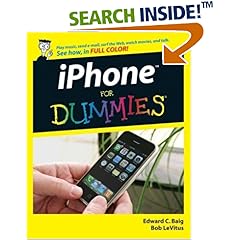
Publisher: Wiley Publishing
Page: 243
2007
As with most products coming out of Apple, the iPhone is beautifully designed and intuitive to use. And though our editors may not want us to reveal this dirty little secret (especially on the first page, for goodness sakes), the truth is you’ll get pretty far just by exploring the iPhone’s many functions and features on your own, without the help of this or any other book.
Part I: Getting to Know Your iPhone
In the introductory chapters of Part I, you tour the iPhone inside and out, find out how to activate the phone with Apple’s partner AT&T, and get handson (or, more precisely, fingers-on) experience with the iPhone’s unique virtual multitouch display.
Part II: The Mobile iPhone
There’s a reason the iPhone has phone in its name. Part II is mostly about all the ways you can make and receive calls on the device. But you’ll also discover how to exchange text messages and play with the Calendar, Clock, and Calculator applications.
Part III: The Multimedia iPhone
Part III is where the fun truly begins. This is the iPhone as an iPod, meaning music, videos, movies, pictures, and other diversions come to life.
Part IV: The Internet iPhone
Part IV covers the mobile Internet. You’ll master the Safari browser, e-mail, maps, and more.
Part V: The Undiscovered iPhone
In Part V you find out how to apply your preferences through the iPhone’s internal settings as well as discover where to go for troubleshooting assistance if and when the iPhone starts misbehaving.
Part VI: The Part of Tens
Otherwise known as the Dummies answer to David Letterman. The lists presented in Part VI steer you to terrific iPhone-related Web sites, provide handy tips and shortcuts, and offer our own suggestions on how you’re newly favored device might get even better.
Download : rapidshare
Programmable Logic Controllers

- Hardcover: 480 pages
- Publisher: Career Education; 3 edition -March 2, 2004
- Language: English
- ISBN-10: 0078298520
- ISBN-13: 978-0078298523
More Review
Download : rapidshare
Buy : amazon Read More......
Electronics Project for Dummies
Electronics Projects For Dummies is a great way to break into electronics or expand your electronics horizons. Here, we provide projects that allow you to dabble in using sound chips, motion detectors, light effects, and more. And all the projects are low voltage, so if you follow our safety advice, no electronics folks will be hurt in the process.
This book provides you with just what you need to get going in the fun world of electronics. It offers projects that you can build in a reasonable amount of time — and in most cases, for under $100 each (some well under!).
You don’t need to be an electrical engineer or have worked on electronic projects in the past. We provide some initial chapters that help you stock up on essential parts and tools, understand what each one does, set yourself up for safety, and master a few simple skills. Then you’re all set to tackle any one of the projects in this book.
More Review
Download : rapidshare
Buy : Amazon
Read More......


